

“If something cannot go on forever, it will stop.”
Herb Stein
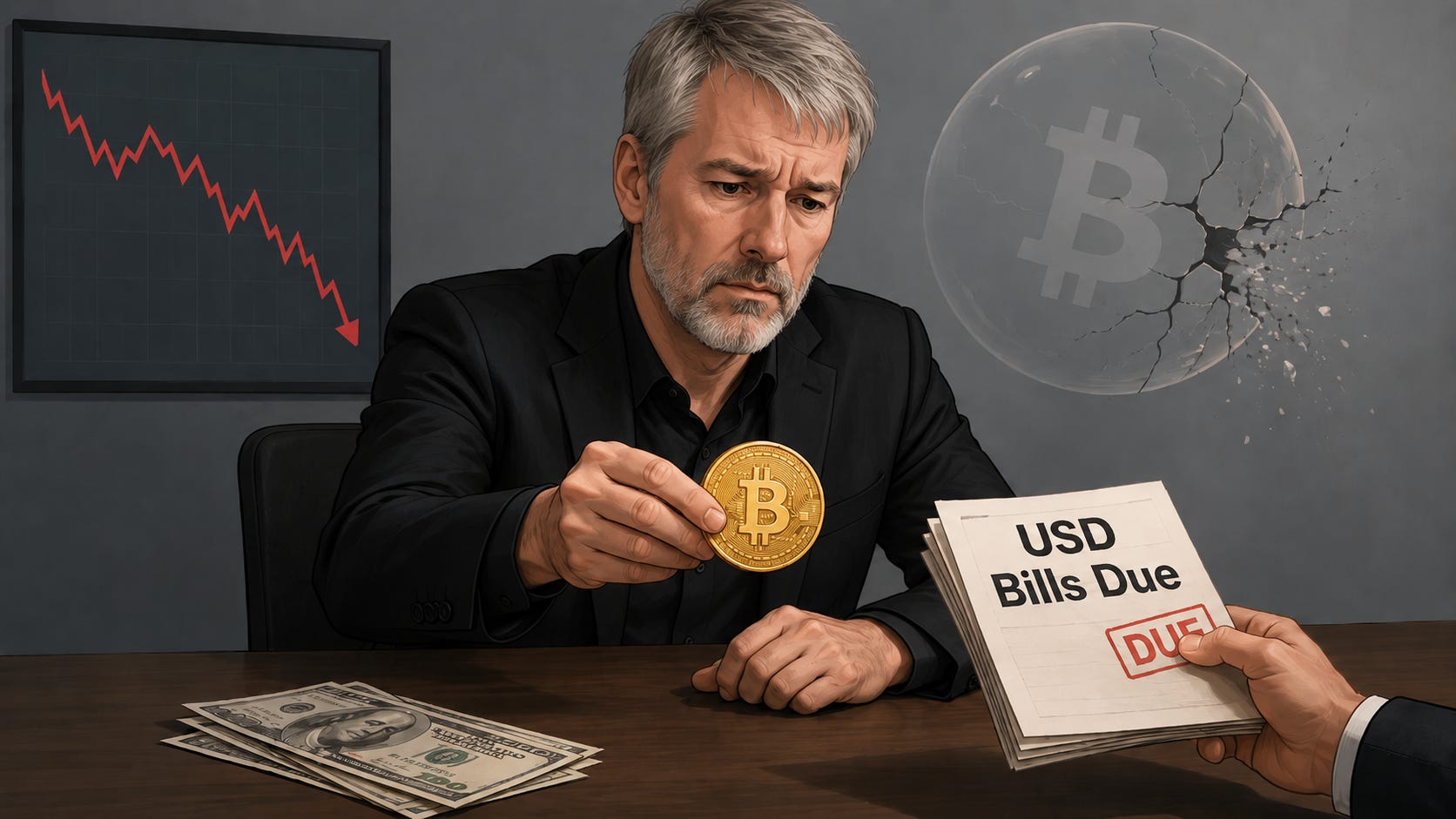
Remember the guy who told you to never sell your Bitcoin? The guy who said you should lever up and sell everything you own to buy more Bitcoin? To mortgage your house and buy Bitcoin?
Remember that guy?
(The fact that the “Family Office Association,” of which I know nothing, created a platform for this nonsense is a topic for another post, although the deadpan expression of the dude on the left speaks volumes.)
Anyway, that guy has started to sell some Bitcoin, because the bills are coming due, and they are payable in USD.
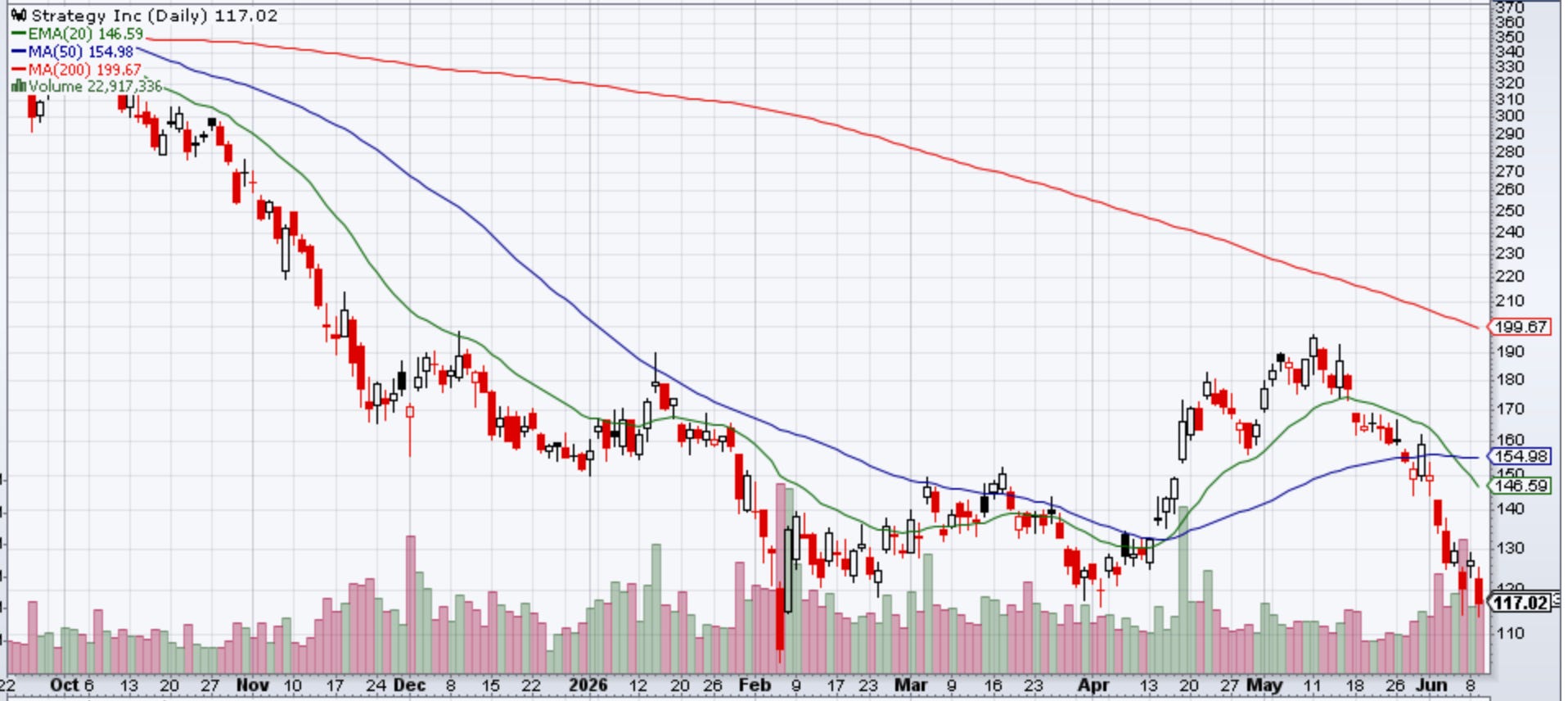
The stock reaction is predictable.
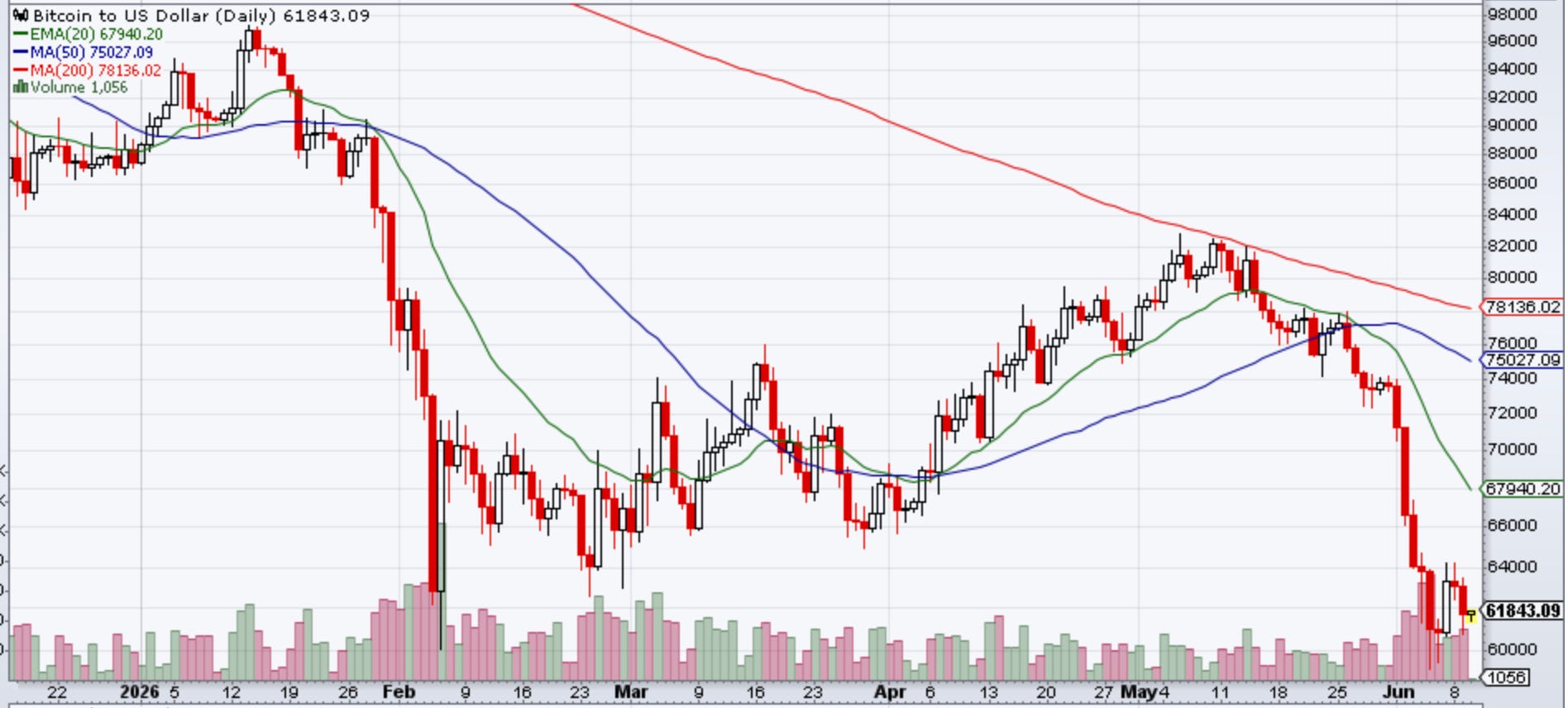
And because there’s a good case to be made that his company has been the source of most of the marginal demand for Bitcoin, the price of the asset itself has also fallen below $60k for the first time since before the “crypto president” was elected.
How we got here
I have friends and clients who have made a lot of money in the crypto space over the past 10 years. And yet I remained steadfast about the fact that I had no interest in participating. In fact, I take pride in missing out. And while there are those moments when I have had the opportunity to say I told you so, this whole silly charade has gone on far longer than I ever expected it to.
Charlatans like Michael Saylor and Tom Lee jumped on to make a quick buck in their Bitcoin and Ethereum “treasury companies,” following the dictum of George Soros who famously said that “when I see a bubble, I rush in.” Lee, to his shame, leveraged his CNBC audience to copy Saylor’s dead-end Bitcoin treasury “strategy” in Ethereum, and erased the majority of the credibility he had built throughout the recent bull market.
As I write this, Saylor and Lee are sitting on combined losses exceeding $20 billion dollars.
This was always a likely outcome, based on the mismatch of assets to liabilities (crypto versus the “fiat currency” that these leveraged plays need to repay). Even if Bitcoin rockets “to the moon,” path dependency matters, and large leveraged players can be the cause of their own negative feedback loop. This is Finance 101, and shame on the huge number of financial analysts and reporters who legitimized this idiocy.
All that to say, that it was as clear as day that the business model for these companies (and others like them) had an expiry date. We are now seeing the very beginnings of this unraveling.
Because if something cannot go on forever, it will stop.
One could indulge in all manner of dubious financial practices with an unruffled conscience so long as prices rose."
-Fredrick Lewis Allen
Time to buy?
You wouldn’t think it by what I’ve written here, but I actually have a lot in common with the Bitcoin crew. I agree with all of their views on the weaknesses of traditional fiat currencies. I appreciate the idea of a “hard” currency that can’t be debased by the perpetual political desire to buy votes with money that doesn’t exist. I really do get it!
The problem is that crypto has become nothing more than a giant casino, and the difficulty of assigning any kind of fundamental value to a Bitcoin makes it a no-go for me. Unlike so many Bitcoin skeptics, I do believe that it has a value… the problem is that it might be orders of magnitude lower than today’s price. One just has to wait for the speculative excess to get wrung out of the price, and this process could take a very long time.
A friend asked me several years ago, “what would it take you to buy Bitcoin?”
What I told him left him incredulous: “I’ll buy after Saylor’s forced liquidation.”
There’s a lot of Bitcoin to be sold between now and then.
SpaceX S&P 500 update
Last week I wrote about the S&P index committee changing their inclusion rules to allow for “fast entry” of all the hot new massive IPOs coming this year. Well, on Thursday they decided against the move, and index investors will have to wait at least 12 months in order to get a piece of that hot SpaceX action.
I’m not commenting on whether or not this is the right decision, but rather using this as another data point on my claim that there is no such thing as passive investing.
An investment in the S&P 500 is essentially outsourcing your investment decisions to a nameless, faceless committee who does not know you, or your risk tolerance, or your investment objectives.
There are better options out there for most wealthy investors.
Would you like your socialism woke, or non-woke?
Okay, so the Republican president has suggested, once again, that the government wants to own pieces of successful companies so that “American people can benefit.”
Specifically, he’s talking about claiming stakes in Anthropic and OpenAI, coming on the heels of the government’s 9.9% stake in Intel.
Republicans are supposed to be fiscally conservative, right? Like free market, small government types? What on earth is going on?
The government already has a huge stake in every company under their thumb. It’s called income taxes, and it’s a pretty effective way to skim profits without having to lift a finger. There is no need to take additional equity in the companies from which it already extracts its share of profits.
Will the AI companies prove to be a special case, or will this set a dangerous precedent? It’s not a huge leap from here to more public “investment” in other important industries, like energy or defence. We’ve already got socialists in the US and Canada calling for government operated grocery stores. It’s a dangerous, slippery slope, as government influence reaches into more and more aspects of our daily lives. It’s not a surprise that opportunistic politicans are using this as a way to buy votes, but it is surprising how economically illiterate the vast majority of the population seems to be, on both sides of the political spectrum.
As Thomas Sowell wrote in Basic Economics,
While capitalism has a visible cost—profit—that does not exist under socialism, socialism has an invisible cost—inefficiency—that gets weeded out by losses and bankruptcy under capitalism. The fact that most goods are more widely affordable in a capitalist economy implies that profit is less costly than inefficiency. Put differently, profit is a price paid for efficiency.
I’m a bit afraid of where this is all headed. If this trend continues, equities may not continue to be the amazing investments they have been in the past. It’s definitely a trend to pay attention to.