

Despite the bearish tone of my last couple of notes, my preferred measure of market breadth is still holding up, and has actually strengthened of late. This certainly doesn’t mean that things can’t roll over from here, but it does make me less anxious about an imminent end to the bull market (unless Iran hostilities flare up again…)
Despite a sanguine outlook, I wouldn’t be making any big bets in the AI infrastructure names right now, nor would I be blindly buying a top-heavy, tech-dominated index fund.
I’m also imploring a friend to sell his basket of semiconductor and memory stocks that is up almost 10x from his cost base.
And it’s not just about tech. A retiree sitting on a pile of Canadian bank stocks should rebalance while valuations are at historic highs. Don’t worry about the capital gains tax, just don’t forget to take a profit!
But despite my negativity on the market in general, I’m not selling stocks. In fact, I’m continuing to buy.
What’s the contradiction here?
The chart below explains my thinking. Let’s teleport back to the top of the telecom bubble. You’ll note that tech had a massive boom and bust, and the broader S&P 500 was down, but take a look at the “S&P 500 ex IT” line below…
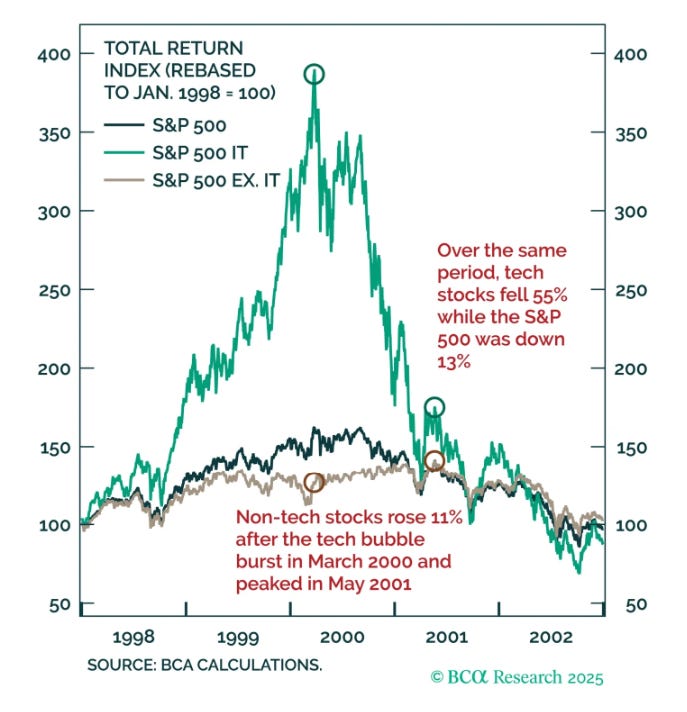
In the wake of one of the biggest crashes in market history, the market, outside of the tech bubble, was actually up 11% in the first year post crash. Tech dragged the S&P down 13%, but the non-tech market held up pretty well.
Consequently, for at least a decade after the bust, when evaluating investment managers, I would look for managers who did poorly in ‘98 and ‘99, and then bounced back in the 2000-01 period. Because this is what any coherent value strategy’s performance looked like.
I feel like we are in a similar period today. Being negative on “the market” doesn’t mean you need to sell it all and go to cash; rather, you can continue to participate in equity upside, knowing that just because “the market” is due for a fall, your portfolio might actually hold up quite well, relatively speaking. And it removes the temptation to try to time the market, because even if you get lucky with a well-timed sale, you need to know when to buy back. The key is to own stocks with decent downside protection. And a little bit of luck can’t hurt, either.