

The measurement problem
Imagine a world where there was no consistent or objective way to measure the size of an object.
Jerry needs to buy a kitchen table for his new house, and calls up his friend Tom, who can build one for him.

“How big a table do you need, Jerry?”
Jerry looks at the empty space in his kitchen and ponders the best way to figure out the size of table he needs. After giving it some thought, he decides he will measure the space by the size of his feet.
“Tom - measuring from heel to toe, I need a table that’s about 6 feet long and 3 feet wide.”
“Sounds good. Should be done in a couple of weeks. I’ll have it delivered and the bill is in the mail.”
Tom dutifully paces out a 6x3 plan for a kitchen table.
“Big table for a mouse…” he thinks to himself. Tom shrugs his shoulders and gets to work.
Upon presenting the table to his friend, he’s a bit surprised to find that Jerry isn’t all that thrilled with the way it turned out.
You see, Tom is a cat, and Jerry is a mouse, and the measure of a “foot” means different things to each of them.

Now this seems obvious, but we do the same thing every single day when we compare the value of a “dollar” across time.
“How does this steak cost 30 bucks? It was $15 a couple of years ago!”
Yes - it was. But a dollar yesterday is not the same as a dollar today.
I mean, the physical dollar itself looks identical, but it’s not the same thing.
If you’re comparing the value of a dollar today to any time more than a few years ago, you’re like Jerry ordering a table from Tom. Bound to be misled by the measurement fallacy.
If you’re happy that you finally “broke even” on an investment that you initially made 20 years ago, I’ve got news for you… you lost a ton of purchasing power. Sure, you have the same value in “dollars,” but those dollars will buy you about half of what they bought you 20 years ago.
The inflation tax
A dollar is not a consistent measurement unit across time. The deterioration of a dollar’s value is generally slow and imperceptible. A dollar worth 2 or 3% less per year isn’t all that noticeable. But over the years and decades, the problem compounds and becomes very apparent. And so the newly retired investor isn’t concerned with inflation when it seems benign, but 20 or 30 years from now, they’ll need a lot more than they thought to maintain their lifestyle. That’s how compounding works.
My parents paid the babysitter $5 an hour. I paid $20. My kids might pay $100. These prices didn’t jump overnight. They increased slowly and imperceptibly, and it’s only when zooming out over decades that we can see the real corrosive impact of inflation.
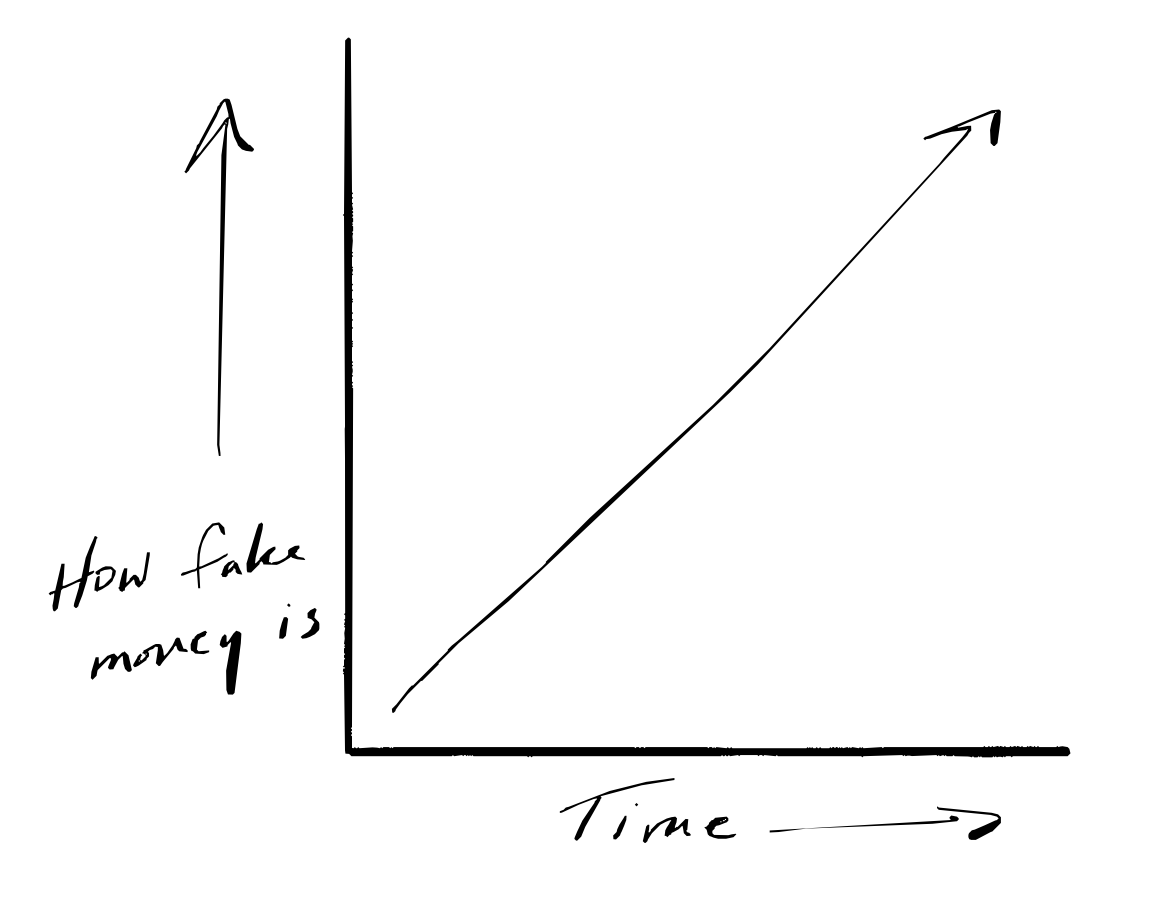
Over longer periods of time, money becomes more fake.
Wittgenstein’s ruler
In the book Skin in the Game, Nassim Taleb describes an idea he calls “Wittgenstein’s ruler.”
By measuring the table with a ruler am I measuring the ruler or measuring the table?
When the price of something rises, we instinctively assume the thing has become more expensive. But there are two sides to that measurement. The thing may have become more valuable. The dollar may have become less valuable. Or both.
The value of the babysitter hasn’t changed over the decades. The measuring stick has.
An example of this in action in real time is The Economist’s Big Mac Index, which uses the globally ubiquitous burger as the benchmark, and various currencies as the items being priced. By doing so, they attempt to evaluate which currencies are overvalued or undervalued relative to others.
This flips the pricing mechanism on its head: rather than the dollar being the benchmark, it’s the Big Mac.
Are we measuring the table, or the ruler?
The more money you have, the more fake it is
I’m writing this piece from the perspective of the long-term investor.
If you need money in the short run, it’s very real. If you need your paycheck to cover your rent and put food on the table, it’s real. Cash comes in, cash goes out. Every dollar is used to acquire a tangible need. Nothing fake about it.
At the stage where you accumulate more money than you need and begin to put it away for the future, it becomes a little bit fake. The more your savings exceed your cash needs, the more fake it becomes.
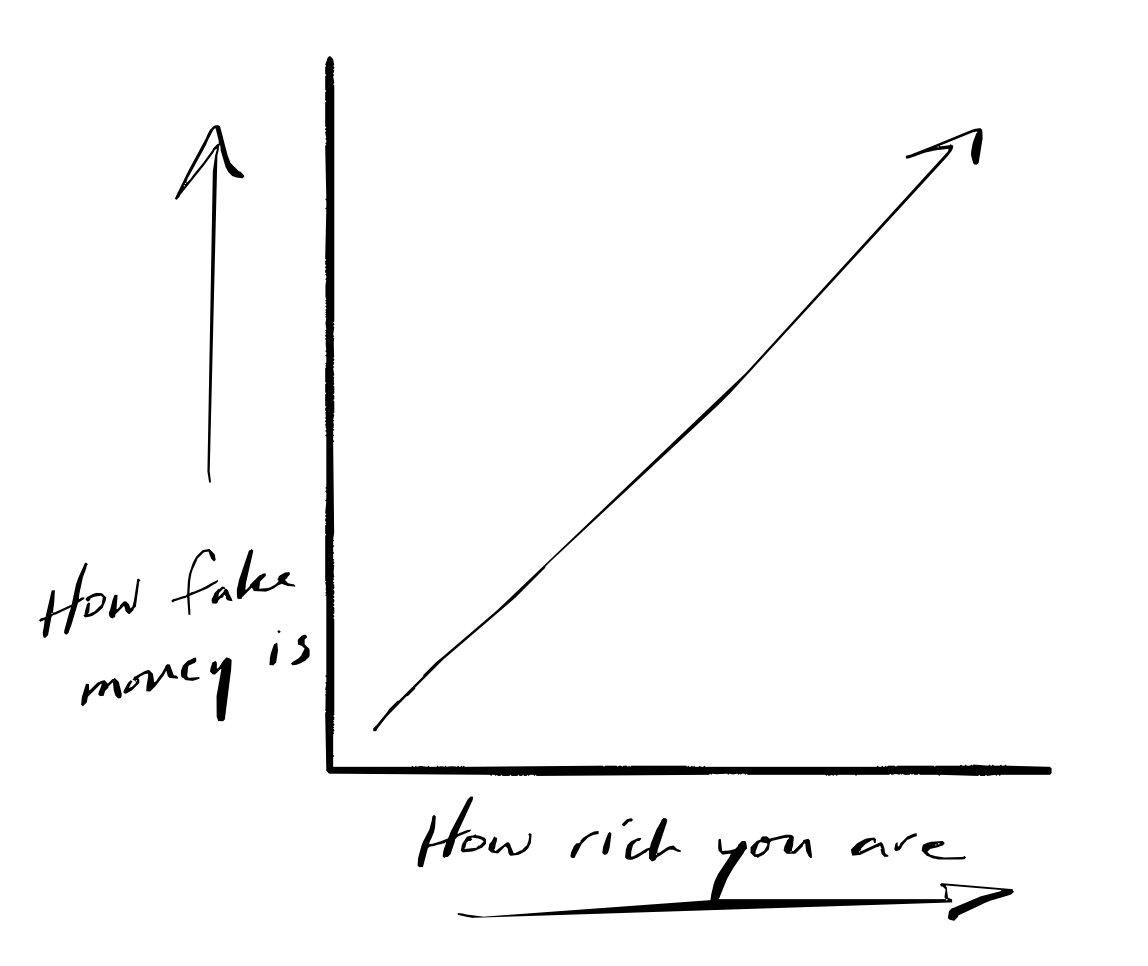
If you’re saving up for a home downpayment, it’s still pretty real. But looking out 30 or 40 years, when you’ll hopefully be enjoying your golden retirement years? Quite fake. And if we’re talking about generational wealth (the kind you’ll pass on to your kids and grandkids), the day to day dollar balance is essentially meaningless.
At this stage, what you need to do is protect your purchasing power, not focus on a number on an investment statement.
This is why one needs a strategy for long-term investment. It’s not only about making more money (although of course it is!), but more importantly, it’s about getting your accumulated wealth out of fake stuff (dollars) and into real stuff (valuable assets). It’s the reason we don’t store our extra dollar bills in a safe under the bed.
It’s a transition that’s important to be aware of. If money is fake to you, congratulations, you’ve made it! Now you’ve got to figure out how to avoid that damn inflation tax, because if you don’t put those dollars to work, they’ll be worth less every year.
In the absence of action to grow your assets, entropy takes hold, eroding the value of your savings.
Call it what it is… dollar depreciation
Governments need you to be confident in their dollars over time because their finances rely on borrowing those dollars from you over decades at very low interest rates. And because they tax you on illusory “capital gains” calculated as if the value of a dollar is perfectly stable over time.
They call it the “inflation rate,” but you can also think of it as the “dollar depreciation rate.” It’s the amount you need to earn just to remain at the same level of purchasing power.
If they tell you that the “inflation target” is 2%, what they are really saying is that they will erode the value of your savings by 2% per year. Oh, you’re earning an interest rate of 4%? That’s cute. After we tax your interest earnings, you’re lucky to break even. And that’s assuming inflation is no higher than target.
Wealth preservation requires you to take control of your destiny. Hiding in bank deposits and bonds is a pretty good way to lose purchasing power.
The value caveat
The title of this piece is clickbait, of course. Money isn’t entirely fake. The price you pay still matters. Your time horizon still matters.
Ask me if I’d rather have a million dollars or half a mill worth of silver coins. I’ll take the cash, thank you.
But tell me that I need to take your gift and bury it in the backyard for 50 years, and I’ll take the silver.
It’s not as simple as that, though.
If the goal is to maintain and grow purchasing power over time, it’s not enough to avoid cash. The assets you buy with cash need to be productive, or limited in quantity (while being desirable and/or useful), or both.
Oh, and you can’t pay too much for them. If you paid too much for Cisco stock in 2000, you didn’t get your money back for 25 years… and accounting for inflation, you’re still down in a big way.
The desire to get out of cash needs to be tempered by an awareness that overpaying for an asset is just prepaying the loss of your dollar’s purchasing power by wasting it on an overpriced asset.
So if you’re reading this and decide that the solution is to put all of your money in precious metals or (God forbid!) Bitcoin, please beware of the risk of doing so: because it’s impossible to value these assets in any reliable way. It’s quite possible that the current prices of gold, silver, and Bitcoin have already priced in several years of future inflation, in which case you’d be overpaying. And there’s really no way to know. Ask anyone who bought gold and silver near their peaks earlier this year, or who YOLO’d into Bitcoin at the top.
So you have to pay attention to value, lest you squander the current dollars, which might be fake in the long run, but have real short term value.
Investing intelligently today is a requirement if you want to protect yourself (and your heirs) against the long-term debasement of your money.
The devaluation imperative
How can we be confident that our dollars will decline in value over time? Well, our political system virtually guarantees that governments will spend more than they take in. Inflation is their escape hatch.
One has to look no further than Donald Trump and Elon Musk’s failed DOGE initiative to see that even with the political will, the job of shrinking the public deficit is against the natural order of things.
Here’s an excerpt from the October 5 edition of the Almost Daily Grant’s newsletter:
Behold a telling exchange from last week’s Time Magazine interview with President Trump:
Trump: Okay, and frankly, this [high rates] is hurting our country more than inflation is hurting our country. More than inflation.
Interviewer: Can you tell us about your meeting with…?
Trump: You know, inflation. Certain levels of inflation will also pay off that debt very rapidly. Very rapidly.
Following those remarks, White House communications director Steven Cheung interjected that the allotted one-hour interview time was nearly complete.
We are a long way from the days of the Tea Party, and the consequences are clear as day for anyone with a recollection of their introductory Macroeconomics course. In the long run, inflation is an inevitability. The only question is how high it will be.
“The biggest risk is not taking one”
This is all pretty grim. If your instinct is to invest in bonds and cash in order to hide from the risk in stocks, you are leaving yourself vulnerable to the ravages of inflation.
Mellody Hobson, CEO of Ariel Investments, said it best:
“The biggest risk is not taking one.”
So how do we combat the perpetual threat of inflation?
My preferred solution is to build a portfolio that gives you just enough risk to get to where you want to go. Not too much. And definitely not too little. We want to dial that risk in just right. You can do this by holding less of your assets in bonds while still minimizing volatility.
Building a more conservative equity portfolio allows you to do this. Focusing on reasonably valued mature companies with strong balance sheets and prodigious cash flows. These businesses tend to have less volatile stock prices and therefore benefit from the low-risk anomaly.
Developing an understanding of which strategies work and which don’t will help you filter the noise and gain confidence in what your own advisor is doing for you. That’s what I’m trying to do here, and what I tried to do in Low Risk Rules.
If you’d like to learn more, follow along.